
The Google Ads vs Meta Ads debate, and the broader PPC vs social media advertising question, is one of the most common decisions businesses face when they invest in paid media. Both platforms can generate strong returns. Both can burn through budget quickly if used without a clear strategy. The real question is not which platform is better in general, but which one is better for your specific business, audience, and goals.
This guide breaks down how each platform works, what each one costs relative to what it delivers, and the scenarios where each genuinely outperforms the other. If you want to talk through the right mix for your business, our PPC agency builds paid media strategies for Australian businesses that connect budget to outcome.
Key Takeaways
- Google Ads targets people who are actively searching for what you offer. Meta Ads targets people based on who they are and what they care about.
- Google Ads tends to deliver stronger results for high-intent, transactional searches. Meta Ads tends to deliver stronger results for brand awareness, product discovery, and visual storytelling.
- Cost per result varies significantly by industry, audience, and creative quality. There is no universal answer to which platform is cheaper.
- Most businesses with sufficient budget benefit from running both platforms together rather than choosing between them.
- The right starting point depends on your sales cycle, your audience’s search behaviour, and how well you can produce compelling creative.
How Google Ads Works
To understand the Google Ads vs Meta Ads comparison properly, start with how each platform finds its audience. Google Ads operates on intent. When someone types a query into Google, they are telling you exactly what they are looking for, right now. Your ad appears in front of them at the precise moment they are searching for a solution like yours. That timing is the core advantage of paid search, and it is what makes Google Ads particularly effective for businesses selling products or services with clear, established demand.
Each time a search is performed, Google runs a real-time auction to determine which ads appear and in what order. Google Ads targeting through keywords determines who enters that auction, and your position depends on your bid, the relevance of your ad to the search query, and your Quality Score. A higher Quality Score means you can achieve strong placement without necessarily outbidding competitors, which rewards businesses that invest in good ad copy and well-matched landing pages.
Google Ads Campaign Types
Google Ads offers several campaign formats, each suited to a different objective.
- Search campaigns: text ads that appear on Google search results pages when someone searches a relevant keyword.
- Shopping campaigns: product listings with images and prices, used by e-commerce businesses to appear in Google Shopping results.
- Display campaigns: visual banner ads shown across the Google Display Network, which reaches sites across the internet.
- Performance Max campaigns: automated campaigns that run across all Google channels simultaneously, using machine learning to optimise for conversions.
- YouTube ads: video ads shown before or during YouTube content, managed through the Google Ads platform.
For most businesses starting with Google Ads, Search campaigns are the natural entry point. They target people with the highest purchase intent and give you the most direct control over when and where your ads appear.
How Meta Ads Works
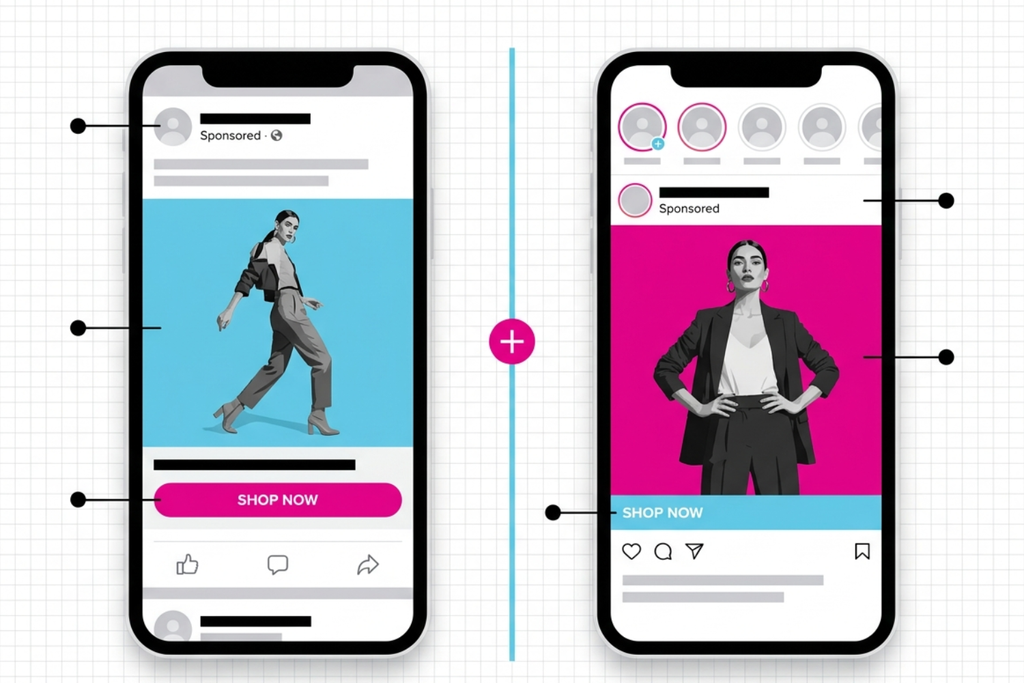
Meta Ads operates on audience targeting rather than intent. Instead of reaching people at the moment they search, you reach them based on their demographics, interests, behaviours, and connections. Someone scrolling through their Instagram feed was not looking for your product when your ad appeared. The job of the ad is to interrupt their scroll and make them interested enough to stop.
Paid search vs paid social comes down to a single distinction: search reaches people who are already looking, while social reaches people who were not. That gap is why creative does so much more of the work on Meta. Strong creative is not a nice-to-have in Meta advertising. It is the primary driver of performance.
Meta Ads Placements
When you run a Meta ad, you are choosing where it appears across Meta’s family of apps and platforms.
- Facebook Feed: the standard scrolling feed, well-suited for longer creative formats and link posts.
- Instagram Feed: a more visual environment that rewards high-quality imagery and short, punchy copy.
- Instagram and Facebook Stories: full-screen vertical content with a short window to capture attention.
- Instagram Reels and Facebook Reels: short-form video placements with strong organic reach amplifying paid content.
- Messenger and Audience Network: extended placements that broaden reach across Meta’s ecosystem.
Meta Ads targeting is handled by a sophisticated algorithm. The algorithm finds the right people within your defined audience once it has good creative and sufficient conversion data to work with. Campaigns with thin budgets or low conversion volume tend to struggle to exit the learning phase, which is why budget and creative investment matter more on Meta than many advertisers expect.
A Platform-by-Platform Breakdown
Putting Google Ads and Meta Ads side by side reveals how differently the two platforms are designed. They differ across every meaningful dimension. Understanding where they diverge helps you decide where to start and how to allocate budget across them.
| Google Ads | Meta Ads | |
|---|---|---|
| User intent | Active: user is searching for a solution | Passive: user is browsing content |
| Targeting | Keywords, location, device, audience layers | Demographics, interests, behaviours, lookalikes |
| Ad format | Primarily text (Search), image/video (Display, PMax) | Image, video, carousel, story, reel |
| Best for | High-intent transactional queries, B2B lead gen | Brand awareness, product discovery, retargeting |
| Creative requirement | Moderate (copy-led) | High (visual-led) |
| Avg. cost per click | Higher in competitive industries | Generally lower, but CPM-based pricing common |
| Learning phase | Faster with keyword control | Longer; needs conversion volume to optimise |
| Audience size control | Limited to search volume | Can scale to very large audiences quickly |
| Retargeting | Available via RLSA and Display | Strong; Custom Audiences across all placements |
Whether you frame it as Meta Ads vs Google Ads or the reverse, neither platform is universally stronger. The comparison above shows that they are optimised for different moments in the buying journey, different types of audiences, and different creative approaches. That is exactly why the most effective paid media strategies tend to use both together rather than treating them as alternatives.
What Does Each Platform Cost?
Cost comparisons between the two platforms are common but often misleading, because the cost per click or cost per impression is rarely the number that matters. What matters is the cost per meaningful outcome: a lead, a sale, a booking, or whatever result your business actually needs.
Google Ads Costs
Google Ads costs in Australia vary considerably by industry and keyword competitiveness. The platform uses a cost-per-click model on Search and Shopping campaigns. Google’s own guidance on how the auction works is a useful starting point for understanding how bids and Quality Scores interact. In Australia, the average cost per click across all industries sits between $1 and $10. Competitive industries like legal services, financial planning, and healthcare can push that to $20 or $50 per click. The reason is simple: if a single lead is worth thousands of dollars to a business, they will bid accordingly.
Beyond cost per click, the metric that determines whether Google Ads is worthwhile is cost per conversion. A $15 click that converts at 10 per cent is a $150 cost per lead. The same click with a 3 per cent conversion rate is a $500 cost per lead. Landing page quality and offer relevance shape Google Ads ROI as much as your bidding strategy does.
Meta Ads Costs
Meta Ads cost in Australia is primarily measured on a cost-per-thousand-impressions basis, though the platform optimises delivery toward the conversion event you specify. In Australia, CPMs on Meta typically range from $5 to $20 depending on the audience, placement, and competitive landscape at the time of running. Meta Ads ROI varies enormously based on how compelling your creative is and how well your offer resonates with the audience you are targeting.
One important distinction is that Meta costs tend to increase as your audience becomes more precisely defined. Targeting a broad interest-based audience is generally cheaper than targeting a narrow, highly qualified audience. This is the opposite of Google, where more specific keywords often deliver better value because they attract higher-intent clicks.
Which Platform Delivers Better ROI?
There is no universal answer, and any source claiming otherwise is oversimplifying. Our experience across full service marketing campaigns shows consistently that ROI depends on the business model, the offer, the creative quality, and how well the campaign is structured and managed. Businesses that track cost per result accurately, test consistently, and optimise on data tend to outperform those that do not, regardless of which platform they use.
Google Ads vs Meta Ads: When to Use
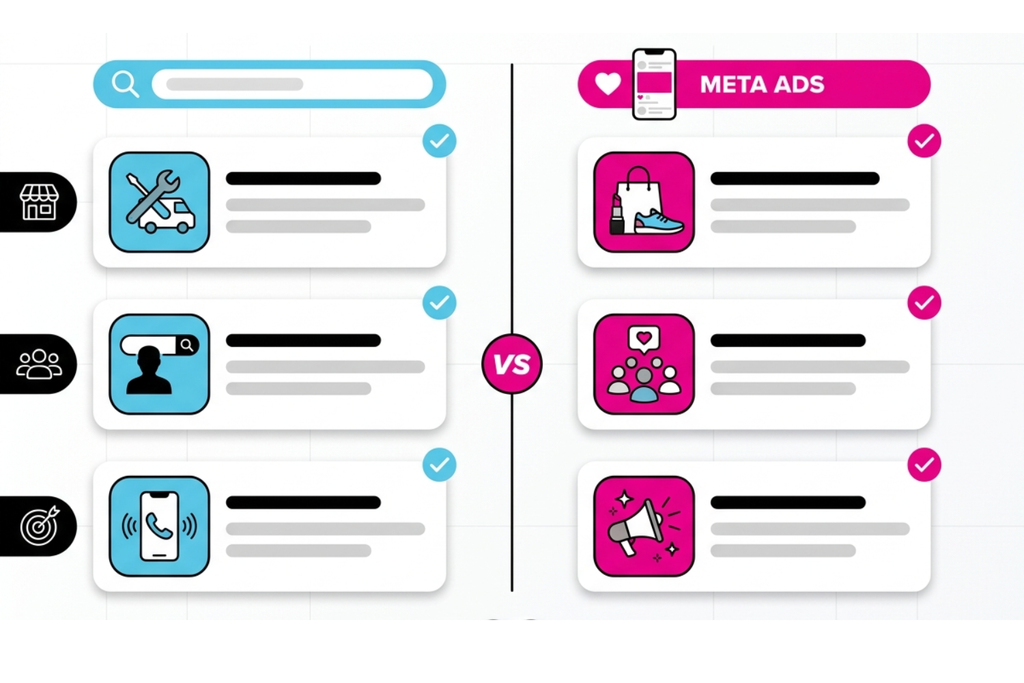
When businesses are weighing Google Ads vs Meta Ads, the decision is rarely binary, but starting points matter. These are the scenarios where each platform tends to deliver stronger results.
Google Ads Is Likely the Better Starting Point When
- Knowing when to use Google Ads starts with search demand. If people are already searching for what you offer, capturing that intent is more efficient than creating it.
- You are in a longer sales cycle and need to reach people at the moment they are actively evaluating options. Service businesses, professional services, and B2B companies often see strong returns here.
- Your audience is defined by what they are looking for rather than who they are. A plumber, a lawyer, or an accountant benefits more from appearing when someone searches than from interrupting someone’s social media scroll.
- You need leads quickly. Google Ads can generate enquiries within days of launching a well-structured campaign, whereas Meta often needs more time to exit the learning phase.
Meta Ads Is Likely the Better Starting Point When
- Knowing when to use Meta Ads starts with your product type. Visual products that benefit from being shown rather than searched for perform naturally here. Fashion, food, homewares, beauty, and lifestyle products perform strongly on Meta because the format suits discovery.
- You are launching a new product or entering a new market where search demand does not yet exist. Meta lets you reach people before they know to search for what you offer.
- Your audience is defined by who they are rather than what they are searching for. Age, lifestyle, interests, and life events are powerful targeting layers that Google cannot replicate.
- You have strong creative assets. If you have compelling images, video, or user-generated content, Meta’s visual formats give you a natural advantage.
- Your goal is retargeting. Meta’s Custom Audiences are among the most effective retargeting tools available, particularly for e-commerce brands nurturing people who have visited their site but not yet purchased.
When to Run Both Together
For most businesses with a budget that allows it, the right answer is both. Google captures demand that already exists. Meta builds awareness and nurtures audiences who are not yet in market but will be. Running them together means you are present at every stage of the buying journey.
A common structure for Australian businesses is Google Search to capture high-intent buyers, Meta to build awareness and retarget site visitors, and email marketing to nurture leads through the funnel. When these channels are aligned under a single strategy, the result is compounding growth rather than isolated campaign results.
How to Choose the Right Platform for Your Business
Choosing between Google Ads and Meta Ads comes down to four practical questions. Rather than a rigid rule, work through each one. The answers will tell you where to start and how to allocate your initial budget.
What does your audience do when they have the problem you solve?
That is the Google Ads vs social media ads question in practical terms. If they open Google and search for a solution, start there. If they scroll social media and get inspired to buy something they were not looking for, start on Meta. Most audiences do both at different stages, which is why the combination tends to outperform either platform alone.
How much conversion data do you have?
Both platforms improve with data, but Meta depends on it more heavily. If you are starting from scratch with no pixel data and no purchase history, Google Search is easier to optimise quickly because you can control intent directly through keywords. Meta’s algorithm needs volume before it can find your best customers reliably.
How strong is your creative?
Running Meta Ads with weak creative is one of the most common ways to waste budget in paid media. If you have strong visual assets, short-form video, or user-generated content that genuinely resonates with your audience, Meta can deliver exceptional results. If your creative is underdeveloped, Google Search is a more forgiving starting point because the ad format is text-led and the intent does the heavy lifting.
What is your budget?
Both platforms have a minimum effective budget below which it is difficult to generate enough data to optimise. For Google Search, a budget of $1,500 to $2,500 per month gives most small businesses enough click volume to make meaningful decisions. For Meta, $1,500 to $2,000 per month is a workable starting point for most audiences, though creative testing adds to that. Below these thresholds, both platforms struggle to exit the learning phase before you run out of data.
The Google Ads vs Meta Ads question does not have a single right answer, but it does have a right answer for your specific business, budget, and goals. If you want to work through that decision with a team that manages both platforms for Australian businesses across Melbourne, Sydney, Brisbane, and beyond, book a strategy session and we will build the case for where your budget should go first.
Frequently Asked Questions: Google Ads vs Meta Ads
It depends on what the business sells and how its customers find it. For service businesses with clear local search demand, such as tradies, lawyers, or clinics, Google Ads typically delivers faster and more predictable results. For product-based businesses where visual presentation drives purchase decisions, Meta often delivers better returns. Google Ads for small businesses tends to work best as the starting point, with Meta added once there is a proven offer and creative to test.
Meta Ads generally have a lower cost per click than Google Ads, but cost per click is not the number that matters. A lower click cost with a lower conversion rate can easily produce a higher cost per lead than a more expensive click that converts well. Compare cost per result, not cost per click, when evaluating which platform is more efficient for your business.
Yes. For most businesses with a sufficient budget, running Google Ads and Meta Ads simultaneously is stronger than choosing between them. Google captures people who are actively searching for what you offer. Meta reaches people who are not yet searching but may be influenced to. Together they cover more of the buying journey than either platform can alone. The key is to align your messaging and offers across both so the experience feels coherent.
Google Search Ads can generate leads within the first week of a well-structured campaign, because you are targeting people who are ready to act. Meta Ads typically take longer to optimise, often two to four weeks, because the algorithm needs conversion data before it can identify and target your best customers reliably. Both platforms improve with time, data, and consistent creative testing.
You need a sufficient budget to generate enough data to optimise, which is different from needing a big budget. A focused $1,500 per month on a well-structured Google Search campaign can deliver meaningful results for a local service business. Meta Ads for small businesses tends to need a slightly higher threshold to exit the learning phase. Spreading the same budget too thinly across both platforms at once often means neither campaign has enough data to perform. Start with one platform, prove the model, then expand.
When people search for Google Ads vs Facebook Ads, they are really asking about Google Ads vs Meta Ads. Facebook Ads sit within the broader Meta Ads platform, which also includes Instagram, Messenger, and the Audience Network. Google Ads and Meta Ads are run by entirely separate companies with separate platforms, targeting systems, and ad formats. The core difference is intent. Google Ads reaches people at the moment they search. Facebook and Instagram Ads reach people based on who they are and what they care about.