The SEO vs PPC debate comes down to a question of time, budget, and what your business actually needs right now. SEO builds organic visibility over months. PPC delivers traffic within days. Both can generate strong commercial results, and both can waste money without a clear strategy behind them.
The difference between SEO and PPC is straightforward at its core: one earns visibility over time, the other buys it immediately. Most businesses do not need to choose one and abandon the other. They need to understand what each channel does well, where each falls short, and how to sequence them so that spend goes to the right place at the right time. This guide walks through exactly that. If you want to talk through the right approach for your specific business, our digital marketing agency works with Australian businesses to build search strategies that match budget to outcome.
Key Takeaways
- SEO builds compounding organic visibility over time. PPC delivers targeted traffic immediately but stops the moment the budget stops.
- Neither channel is universally better. The right choice depends on your timeline, your budget, and how your audience searches.
- For most businesses, the strongest position is using both channels together rather than treating them as competitors.
- Short sales cycles, time-sensitive offers, and new market entry tend to favour PPC. Long-term authority building and cost efficiency over time favour SEO.
- The businesses that get the most from search marketing tend to use PPC to generate early cash flow while SEO compounds in the background.
What Is SEO and How Does It Work?
Search engine optimisation improves your website so it appears higher in the unpaid organic listings on a Google results page, the ones that appear below the sponsored ads. When someone searches for a service or product you offer, SEO is what determines whether your business appears on page one or page five.
SEO works across three main areas. Technical SEO covers the structural health of your website: how fast it loads, how well search engines can crawl it, and whether the code gives Google what it needs. On-page SEO covers the content and structure of each page: the keywords used, the headings, the internal links, and the quality and relevance of what is written. Off-page SEO covers your website’s authority in Google’s eyes, primarily through backlinks from other reputable websites pointing to yours.
The defining characteristic of SEO is that it takes time. Most websites take three to six months to see meaningful ranking improvements from a new SEO campaign, and building strong authority in a competitive market can take considerably longer. That lag is the most common reason businesses underestimate SEO; the investment precedes the return by a significant period.
What SEO Delivers Over Time
The case for long-term SEO investment is not just that it is free. It is that the results compound. A well-optimised page that earns a strong ranking can drive qualified traffic for years without ongoing spend. The SEO benefits grow as you build more content and authority, which is why established businesses with mature programmes often achieve the lowest cost per acquisition of any digital channel.
What Is PPC and How Does It Work?
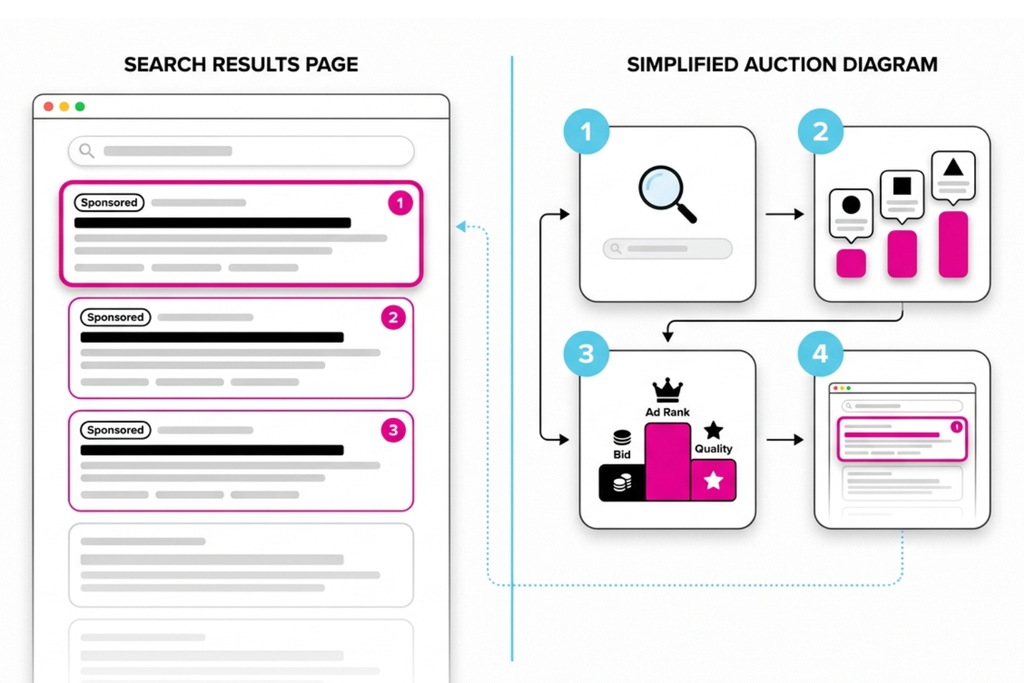
On the PPC side of the SEO vs PPC comparison, pay-per-click advertising lets you buy placement at the top of search results. With Google Ads, the most widely used PPC platform in Australia, you bid on keywords relevant to your business, and your ad appears when people search those terms. You pay each time someone clicks your ad, not each time it appears.
Unlike SEO, PPC does not require you to earn your position over months. A well-structured campaign can be live and generating clicks within days of launch. Speed is one of the core PPC advantages. It is particularly valuable when a business cannot wait for organic rankings to build: a new product launch, a seasonal promotion, or a market where competitors already have a significant organic head start.
The trade-off is dependency. PPC traffic exists only for as long as the budget continues. The day you stop paying, the traffic stops. There is no residual value in the way that strong SEO content or earned backlinks continue to work for you after the initial investment.
PPC Beyond Google Ads
While this post focuses on SEO vs paid search in the context of Google and organic results, PPC extends well beyond search to paid social on platforms like Meta, LinkedIn, and TikTok. For a detailed comparison of the major paid platforms, the Google Ads vs Meta Ads guide covers that decision in full.
A Channel-by-Channel Breakdown
The SEO and PPC contrast runs across every meaningful dimension: how results arrive, how they are costed, and how long they last. Understanding the contrast across each of these dimensions is the clearest way to see which one suits your current situation.
| SEO | PPC | |
|---|---|---|
| Time to results | 3 to 6 months for meaningful movement | Days from campaign launch |
| Cost model | Investment in content, links, and technical work | Cost per click, ongoing budget required |
| Longevity | Results persist after investment stops | Traffic stops when budget stops |
| Targeting | Keyword and topical relevance | Keywords, location, audience, device, time |
| Click-through rate | Higher for branded and informational queries | Higher for commercial and transactional queries |
| Trust signals | Organic listings carry more implied trust | Ads clearly labelled; some users skip them |
| Scalability | Scales through content and authority over time | Scales immediately with budget increases |
| Best for | Long-term authority, cost efficiency over time | Speed, testing, seasonal demand, new markets |
Looking at organic search vs paid search, longevity is the most important difference for budget planning. PPC spend is an operating cost: stop paying, and you stop appearing. SEO investment is closer to a capital asset: once a page earns a strong ranking, it continues to generate returns. That distinction changes how you should think about the cost of each channel.
How the Costs Compare Over Time
Cost comparisons between SEO and PPC are often misleading because they compare the wrong things. The relevant question is not which channel costs more per month; it is which channel delivers a lower cost per acquisition over the period that matters to your business.
The Real Cost of SEO
SEO is not free. A serious SEO programme involves ongoing investment in content production, technical website work, and link building. For most Australian businesses working with an agency, this sits between $1,500 and $5,000 per month depending on market competitiveness and the scope of the work. The cost feels significant in months one through six when results are still building. The arithmetic changes completely at month twelve or twenty-four, when strong rankings are delivering consistent traffic at a fraction of what equivalent PPC traffic would cost.
The measure that makes SEO’s value clear is cost per acquisition over time. Early in an SEO programme, cost per acquisition is high because the investment is front-loaded and results are thin. As rankings establish and traffic grows, cost per acquisition falls, sometimes dramatically, while the spend stays relatively flat. That declining cost curve is the defining commercial argument for SEO investment.
The Real Cost of PPC
PPC costs in Australia vary enormously by industry and keyword competitiveness. According to Ahrefs industry benchmarks, in low-competition categories, clicks might cost $1 to $3. In competitive service industries like legal, financial planning, or healthcare, cost per click can reach $20 to $60 or more. Beyond cost per click, the metric that determines PPC’s commercial value is cost per conversion, what you pay for each lead, sale, or booking generated.
Because PPC costs scale linearly with volume, there is no improving cost curve the way SEO offers. A business spending $5,000 per month on PPC in year three pays roughly the same per conversion as it did in month one. The channel delivers consistent, controllable volume, but it does not get cheaper over time. That flat cost structure is why most businesses benefit from treating PPC as a bridge while SEO builds, rather than a permanent primary channel.
PPC vs SEO Cost: Which Wins?
Looking at PPC vs SEO cost over a short horizon, PPC often wins on cost per acquisition because it generates results immediately while SEO is still compounding. Over a longer horizon, typically 12 to 24 months, a well-executed SEO programme usually delivers a lower cost per acquisition than sustained PPC spend in the same market. The crossover point varies by industry and competitiveness, but it almost always comes.
SEO vs PPC: When to Use
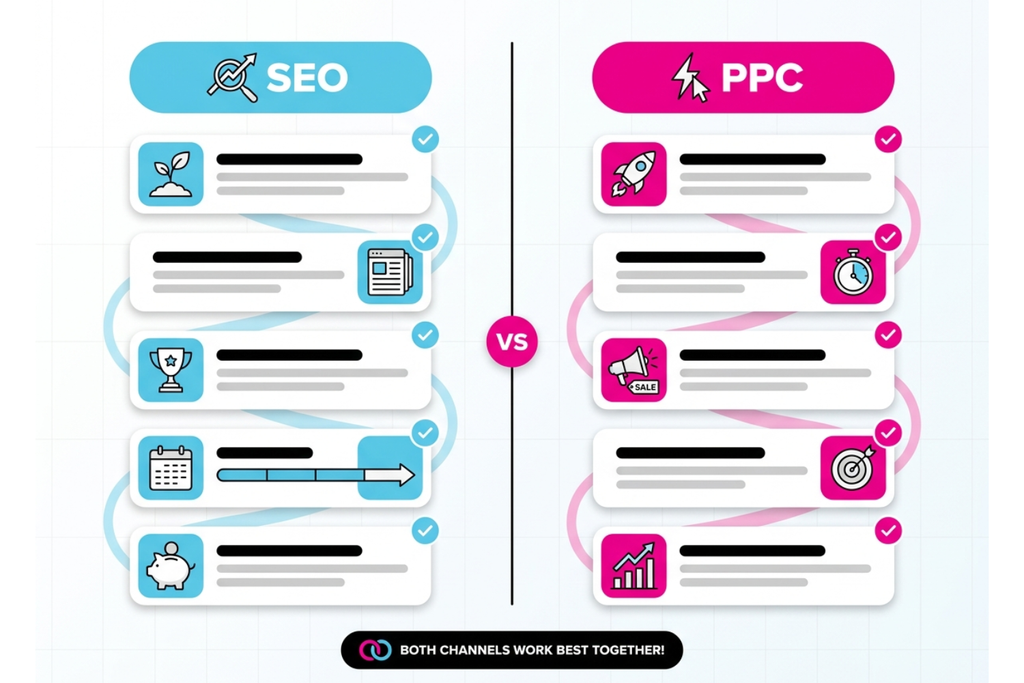
When weighing SEO vs PPC, the right channel depends on your specific situation. These are the scenarios where each strategy tends to deliver the strongest return.
SEO Is Likely the Right Starting Point When
- Knowing when to use SEO starts with your timeline. If you are building a long-term digital presence and can accept a 6- to 12-month ramp-up, SEO is right for you.
- Your market has established search volume for the services you offer. If people are already searching for what you do, ranking for those terms delivers highly qualified traffic over time.
- Your competitors are ranking organically and taking traffic that should be yours. A sustained SEO programme is the only way to displace them in organic results.
- Your business model produces a high customer lifetime value, making a longer acquisition cycle worthwhile. Professional services, SaaS, and subscription businesses often find SEO delivers their best long-term economics.
- You want to build an asset. Unlike PPC spend, strong SEO rankings have residual value that persists after the active investment period.
PPC Is Likely the Right Starting Point When
- Knowing when to use PPC starts with urgency. If you need leads or sales now, PPC is the fastest way to generate measurable traffic from search.
- You are launching a new product, service, or business and have no organic presence yet. PPC lets you generate revenue while SEO builds.
- You are entering a market where competitors have years of SEO authority. PPC levels the playing field immediately while you build organic credibility over time.
- You are testing messaging, offers, or markets. PPC provides fast, clean data about what resonates before you commit to a long-term content or SEO strategy.
- You have seasonal or time-sensitive demand. A promotional campaign, a product launch window, or a seasonal peak can be captured with PPC in ways that SEO simply cannot match on a short timeline.
When Both Channels Work Together
Running SEO and PPC together is the strongest position for most established businesses rather than choosing between them. PPC captures high-intent buyers immediately while SEO services build organic authority in the background. As rankings build, PPC budget can be reallocated away from keywords where you now rank organically and toward new opportunities or harder-to-win competitive terms.
A sound SEO and PPC strategy for Australian businesses is to use PPC to prove a market works commercially. Once you have that proof and that revenue, it funds the SEO investment that makes the channel sustainable long term. The two strategies reinforce each other rather than compete.
How to Decide Between SEO and PPC
The decision comes down to four practical questions. Work through each one. The answers will point you toward the right starting point for your business.
How urgent is your need for leads or revenue?
If the business needs leads within the next 30 to 60 days, PPC is the only viable search marketing option. SEO cannot deliver results on that timeline. If you have six months or more to invest before expecting strong returns, SEO becomes the more economical long-term choice.
How competitive is your market in organic search?
Search industries like legal services, financial planning, and real estate in major Australian cities are highly competitive in organic search. Displacing established competitors takes significant time and investment. In those markets, PPC is often more cost-effective in the short term, and the parallel SEO investment is best treated as a multi-year programme.
Do you have a content and link-building capability?
SEO requires consistent production of quality content and the ability to earn or build backlinks from credible sources. Without that capability in-house or through a specialist like our content marketing agency, a PPC-first approach is more practical. PPC requires budget and campaign management skills, but it does not depend on content production at scale.
What does your sales cycle look like?
Long sales cycles with multiple decision-makers favour SEO, because the channel builds authority and trust over time in a way that supports a considered buying decision. Short sales cycles with transactional intent, trades, local services, and e-commerce tend to respond well to PPC because the buyer is ready to act and just needs to find you.
The SEO vs PPC question rarely has a single correct answer, but it always has a most useful starting point for your specific business, budget, and timeline. Our team works with businesses across Melbourne, Sydney, Brisbane, and across Australia to build search strategies that sequence both channels intelligently. Book a strategy session, and we will work through exactly where your budget should go first.
Frequently Asked Questions: SEO vs PPC
There is no universal answer: SEO vs PPC, which is better depends entirely on your situation. SEO delivers compounding returns over time and builds an asset with residual value. PPC delivers traffic immediately but requires ongoing spend to sustain. The right choice depends on your timeline, budget, and how urgently the business needs results. For most businesses with a sufficient runway, SEO delivers better long-term economics. For businesses that need leads now, PPC is the faster path.
PPC can generate traffic within days of launching a campaign. SEO typically takes three to six months to produce meaningful ranking improvements, and building strong authority in a competitive market can take 12 months or more. The lag is the most common reason businesses underestimate SEO’s value; the investment period precedes the return period by a significant margin, which makes it feel less effective than it actually is.
Over a short timeframe, PPC often delivers a lower upfront cost per conversion because it generates results immediately. Over a longer timeframe, typically 12 to 24 months, a well-executed SEO programme usually produces a lower cost per acquisition than sustained PPC spend in the same market. SEO’s cost structure improves over time because the channel compounds. PPC’s cost structure stays relatively flat, since you pay for every click regardless of how long you have been advertising.
Yes, and for most businesses with sufficient budget, running both in parallel is the strongest approach. PPC captures high-intent buyers immediately while SEO builds organic authority. As organic rankings strengthen, you can shift PPC budget away from keywords you now rank for organically and redirect it toward more competitive terms or new opportunities. The two channels reinforce each other when managed with a clear strategy.
When weighing SEO or PPC for small business, PPC is often the faster path. Local service businesses can run a well-structured PPC campaign and generate consistent local leads at a manageable cost. The key is starting with a focused keyword set, a realistic budget, and a landing page that converts. Spreading too thin across many keywords on a small budget is the most common mistake. A disciplined, targeted PPC campaign at $1,500 to $2,000 per month can deliver strong results for a local service business.
SEM stands for search engine marketing, which is an umbrella term covering both SEO and paid search advertising. Some practitioners use SEM specifically to refer to paid search, but strictly speaking it encompasses all activity aimed at increasing visibility in search engine results pages, whether paid or organic. When a business says it is running SEM, it is typically running PPC campaigns. SEO is the organic component of search engine marketing.